Showing posts with label game. Show all posts

06 October 2008

Crow's-Feet: A Story-Games Contest Response

I occasionally design games in response to online contests. Some people do it often and produce great stuff. That's not me, but it's still fun. I wasn't really in the make-a-game mode, but something about Jonathan's post at SG kept rattling around in my head and out came the following. I think it's playable in an hour -- even if some people would take longer, I'll try it out and see how it works. I guess I've disregarded the rule about no writing implements at the table — I kind of forgot about that while the idea flowed out of me. I think I'll leave it like that rather than implement some inane replacement like pressing the crow's-feet into aluminum foil with your finger-nail. Also, when I started, I'd kind of expected the graphical role of the illustrated crow's-feet to have a more numeric role in resolution or something but that's not how it worked out.


Crow's-feet
-any of the tiny wrinkles at the outer corners of the eyes resulting from age

Players are expected to be sitting around a table or something. There are the same number of characters as there are players but each character resides between two adjacent players who share it — so that each player has two characters and each character has two players. Each character is represented at the table by a youthful, cut-out face. (To generate these, take pictures, tear them out of magazines, find them on the net, draw them up, use my templates below, whatever.)

These characters that you'll be playing with were in more or less the same clique in high school, twenty years ago. Maybe they're still friends and maybe not. Probably not really; but y'know, friendly. It's a funny time in their lives because high school graduation was such a significant milestone and now they've lived more life after that point than before. And they've seen quite a bit and really lived their lives for a while. Experiences have left tracks on the characters. They've aged.

Aging has good parts and bad and different people react and emphasize these aspect differently. And I think that the way we handle these things has some impact on the way we age. Take crow's-feet; maybe this is myth — though for purposes of this game it isn't: when you laugh and smile a lot, you develop wrinkles radiating out from your eyes in a generally downward direction and when you scowl more, your crow's-feet point more out and up. That's how you'll be recording the story of the characters — by illustrating their crow's-feet. And by calling on those illustrations to influence more of their stories.

So now you're sitting around the table with some friends and you have these cut-out faces lying on the table's surface between you and your neighbors...now what? Grab a fine-point sharpie (or whatever) and the character's face to your right. Write her first name on her forehead — way up high, and put her back on the table. Someone has to start — let's say it's the oldest player. He's going to pick one of his characters and describe a bit of a situation. It'll be either historic or current for the character.

See, the setting of this game is like this: It's late on the evening of their twentieth class reunion — after things have shut down and they've moved, as a group, to someone's house. They talk about the good old days, but more, they talk about Real Life; what's been going on. You're past the bullshit part of the evening and old friends have been reexamining their lives all day. Maybe they've had a few drinks. Now they're confiding.

When it's your turn, you come up with a situation of significance in the character's life; something that helped them to mature. Anything, really. But don't be trying to narrate an outcome — the group will do that collaboratively, just set something up and as play proceeds, you'll learn some cool stuff about the characters.


kidislackingsecurity
partnercausesbuildingsatisfaction
jobexacerbateslosingsufficiency
money
showingexcitement
parent
conflictedheartache
news
socialanxiety
technology

healing
body

function

You can come up with any kind of situation that will lead to significance, but if you want some help, check out this table. There are four lists of words. you can string them together, adding the occasional "not," changing the tense or form and even adding or deleting a word as you want — this is just a helper. For example, maybe you grab "money causes social satisfaction" and set up a situation in which the character, aspiring to "success" can finally buy into a country club or maybe he hires a prostitute to help fill the gaps in his lackluster marriage. Some combinations won't make perfect sense; just fix them up or choose something else.

So one player (whomever is "on") sets up a beginning situation for one of his characters — describing in a few sentences what's going on: setting, initial actions and goals. Then he holds up the character's face and shows it around. if it is after the first round of play, the character is likely to have some crow's-feet. Each player should let the face inform their narration. (How you do that — seeking balance or considering the prior direction a tipping point, is up to each of you on your own.) From this starting place the players will take turns contributing to narrating what happens.

There are two formats to this: narration and dialogue. Some groups do most of the play as that kind of narration. Others will want a bunch of in-character dialogue. They're both quite nice ways to play.

Narration is as simple as this: the players take turns adding one sentence (or so — one main point, anyway) to the description of actions and reactions. Go clockwise around the table. Say whatever follows most obviously from what the player before you said. Don't take a bunch of time to think of something cool — trust that it'll be most cool by just riding the collaboration. And you want to keep the game moving; keep people engaged. That's narration. (Please note, this character is revealing a story. As such, a few things can't happen in the story -- like the character's death, at least. Usually.)

When speaking for a character, if the character happens to be one of the main characters — the ones on the table, then that character is spoken for by one of her players. (The player with the same left-right relationship to the character as the player who set this situation has with his character is ideal.) If it's some other character, the first person who wants to talk for her can speak up and run with it. If no one does that, it's the first player to the left of the player who set the situation up who isn't already engaged in the current dialogue. You can shift back and forth between narrative and dialogue freely — just remember who narrated the last bit so it can pick up with the next player.

This story-telling/acting round ends when the situation is naturally resolved. This will usually be obvious, but you can also check to see when everyone agrees that there's nothing more to add. In practice, these scenes just run out of steam and then you know that it's time to move on. At this point, the two players of the character for whom the recently ended situation was authored take a moment to reflect on the outcome of the story and illustrate a crow's-foot on the character's face — on the eye closest to the player. If you think that it was a positive growth outcome, angle the crow's-foot downward. If not, then upward. If it was strongly one or the other, curve it quite a bit. If you think the event had powerful impact on the character's life, make the line you draw a little wider/darker/deeper.

When one situation is resolved, the next player (to the previous player's left) chooses one of her characters and repeats the process. Note that you could play two situations in a row for the same character — it's up to you each round. Repeat this cycle until everyone has set up and resolved a situation. At this point, each player will have "judged" and drawn two crow's-feet. Call that a round. You should play the game as many rounds as you find interesting. I'm writing this with no play-testing, so it's only a guess, but I'd hope that after three rounds you'd have an interesting assortment of crow's-feet illustrated and you'd know some things about the characters.

Facial Resources:
I'm not sure what's legal in the way of grabbing images to retouch and present here, but I also didn't want to leave you with merely a mandate to supply big faces. So here's what I'm doing. There's a list of links below that seem like good resources. Either import faces from the following links, into a graphics editor and tweak and resize them for printing or just print them so they fill the page. These should get you started — I'm particularly fond of the first site.

A site dealing with computer-composited faces
One of what must be tons of modeling sites
Another
Another composite face.

Also, the software used by that top link is available here. If you wanted to morph a few pictures together from the net so that any trace of their origin was gone and so that they would be pretty generic, this would be a good tool. I hope to find time to do this in the next few days and I'll post a face or two here if that works out. And if you do that, let me know!


If anyone has suggestions or comments, I'd love to hear them — particularly improvements to the situation-word table.

10 July 2008

Party game design

1:30 - Using Brenda Brathwaite's article, Easiest Game Design Exercise Ever I decided to make a silly little game quickly. Also, I need text-heavy stuff to do in order to practice working with my new keyboard.

Right off the bat I'm aiming for a somewhat risque party-game since I don't have any experience inventing such a thing.

1:39 - Step 1 - So let's say there are twenty spaces on our track.

1:40 - Step 2 - Must...choose...narrative... OK, so I really prefer an abstract, but I want to follow this exercise. I want to have some social play elements ( so I want it to be social like running for class president or something but kind of more grown up. Um...like a successful party host(es) or something. Yeah, that'll do -- Party Time.

2:10 - Step 3 - My first impulse was to violate the rules here, but I've gone back and decided to *really* follow this as closely as possible and see what I get. I'm going to just "go with dice" but I want there to be three or four sources of movement in step 4 and I want them to be relatively more powerful than the random movement of the dice. I want the dice to result in a distribution with a low kurtosis. What I'd really like is 3d2 or something but I think that's impractical -- flipping coins sucks compared to rolling dice. After goofing around for a bit I think I'll go with Roll three dice (d6) and take the lowest roll as the mechanic. It gives a slight chance of extraordinary movement (six spaces) but you're about 70% likely to move only one or two spaces. This also allows future developments to alter the die-mechanic.

2:49 - Step 4 - Conflict. I'm not sure about calling this conflict but I want a few position-modifying mini-games. Maybe once they're fleshed out the board will just have one of them on each space or maybe they're the result of a card-draw. The trick now is to figure out what they are. I'd like to have at least four mini-games and ideally, more. I'd like them to extensible -- fitting expansions and player-generated content in seamlessly and allowing certain Challenges (I think that's what I'm calling them) to be removed to fit the tastes of the play-group. I'd also like for the Challenges to result in a net movement of <2 spaces -- so some player(s) might advance or fall back up to two spots or maybe some of each would happen but only up to one space in each direction -- and if this were occasionally violated, no biggie.

Challenge 1: Who here has (never) done...? The way this works is that the Focus player (she who triggers the Challenge) selects a question about past deeds for which her truthful answer is "me" (indicated with a raised hand) and presents it to the crowd. (E.g. "Who here has driven over 100 MPH?" or "Who here has drawn a lover's blood with your teeth?" or "Who here has never skied?") Every other player either raises their hand, indicating that the statement is true for them too, or does nothing indicating that it is not. If no hands are raised, the focus player advances two spaces. If fewer than half the hands are raised then the focus player advances one space.

Challenge 2: Color-Match When using this Challenge, a pile of colored cards or tokens or something must be available. (For testing, I'd like to get a pile of color chips from the paint department at Home Depot or something.) The focus player select a color randomly, drawing it and revealing it to all the players. If that player is wearing a garment that is pretty close in color to drawn color (as determined by a consensus of fellow players) then the focus player has two options. If not, skip the first option below and execute the second.

2a: If the focus player is wearing a garment of close color she may opt to apply the color test rules to herself rather than seeking out the closest match as per the paragraph below. If she happens to wear the closest match in the game, then the option is moot.

2b: The player wearing a garment that is closest in color to the selected color must go back two spaces. If that player would rather, he may remove the garment and instead go forward one space.

Challenge 3: Kiss Your Neighbor When playing with this Challenge module, there is a play aid -- a card with five strata each listing one of, in order: hand, arm, lips, neck and tongue, upon which a pawn rests and moves. The pawn begins the game on the lowest (hand) space. When the focus player lands on a KYN space, he must consult the play aid and kiss one of the players adjacent to him -- the one he has kissed the fewest times if applicable, otherwise his choice. If he will not, he loses two spaces. If he kisses the neighbor in a place and manner appropriate to what is indicated in the space with the pawn, he advances one space. The focus player also has the option of kissing his neighbor as per the space below or above the pawn's current location, subtracting or adding one to the number of spaces gained. Further the pawn is moved up a space on the play aid each time a kiss is conducted earning one or two spaces gained on the victory track. The point of the kiss-location track is to escalate the passion and intimacy of the kiss. To play this appropriately, the meaning of each space should be apprehended with this in mind.

Challenge 4: A Round of Greetings The focus player is to address each other player starting with the player to her left and continuing in clockwise order as if she were the host of a party and were greeting guests as they arrive. Each greeting should include physical contact where practicable (maybe only with adjacent players if your game space doesn't permit freedom of movement), direct eye-contact and a compliment. The focus player receives two space-advances minus one for every fellow-player who thought the act implausible.

Challenge 5: Art Contest The focus player names a subject for the other players to draw. Each other player is given a small piece of paper and a pen or pencil and attempts to draw the named subject. This should take just a few minutes. The focus player then collects the drawings and judges them -- selecting a winner. The drawer of the winning picture advances one space. Then, the focus player's judgment is judged. If every player agrees with the judgment, the focus player advances two spaces. If not, but every player agrees that it was a reasonable or plausible judgment, the focus player advances one space. If not, and every player suspect the focus player of gaming the judgment then the focus player loses a space.

etc.

I'm now thinking that the way to do the board is to just assemble a small deck of cards/spaces based on the modules you're playing with and the relative frequencies desired and then shuffle them up and lay them out making a dynamic board.

5:07 - Step 5 - Oh, I'm done. There you go!

25 April 2008

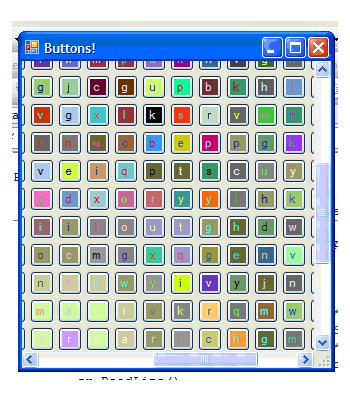
Buttons!: a software toy


So I've been messing around with an idea that was nagging at me for a game that I could write. Only it's not really a game. I remember one of the early Maxis Sim-* games calling itself a software toy. That's what Buttons is. It's kind of a puzzle and kind of a toy. It may turn out that it was more fun for me to make than for you to play with. And I'd kind of like to make it more of a game. If you have any thoughts on how I'd do that, I'd love to read them.

You'll see things change on the screen as you interact with it. Also note that right now there are two menu options to alter the environment.

Download the Buttons installer (for Windows) here.